Step 2 — Problem Definition
⏱️ At a Glance Step 2 of 5 — and the most important one. Write one dense paragraph covering: what's broken, who it affects, and a number that proves it's a real problem. Vague input here means a vague, generic BRD later — specific input here means a sharp one.
The Problem Definition step captures the real-world pain points your project addresses. The more specific and data-driven your inputs, the more precise your AI-generated documents will be — this is the single highest-leverage step in the entire brief.
This stage captures three dimensions:
- What is broken — the current failure or gap
- Who is impacted — teams, customers, or systems affected
- Which metrics are failing — quantifiable indicators of the problem
Steps
- In the input field, describe what's broken, who's impacted, and which metrics are failing.
- Craft a clear problem statement that captures all three dimensions in a single, dense paragraph.
- Click Back to return to Project Overview.
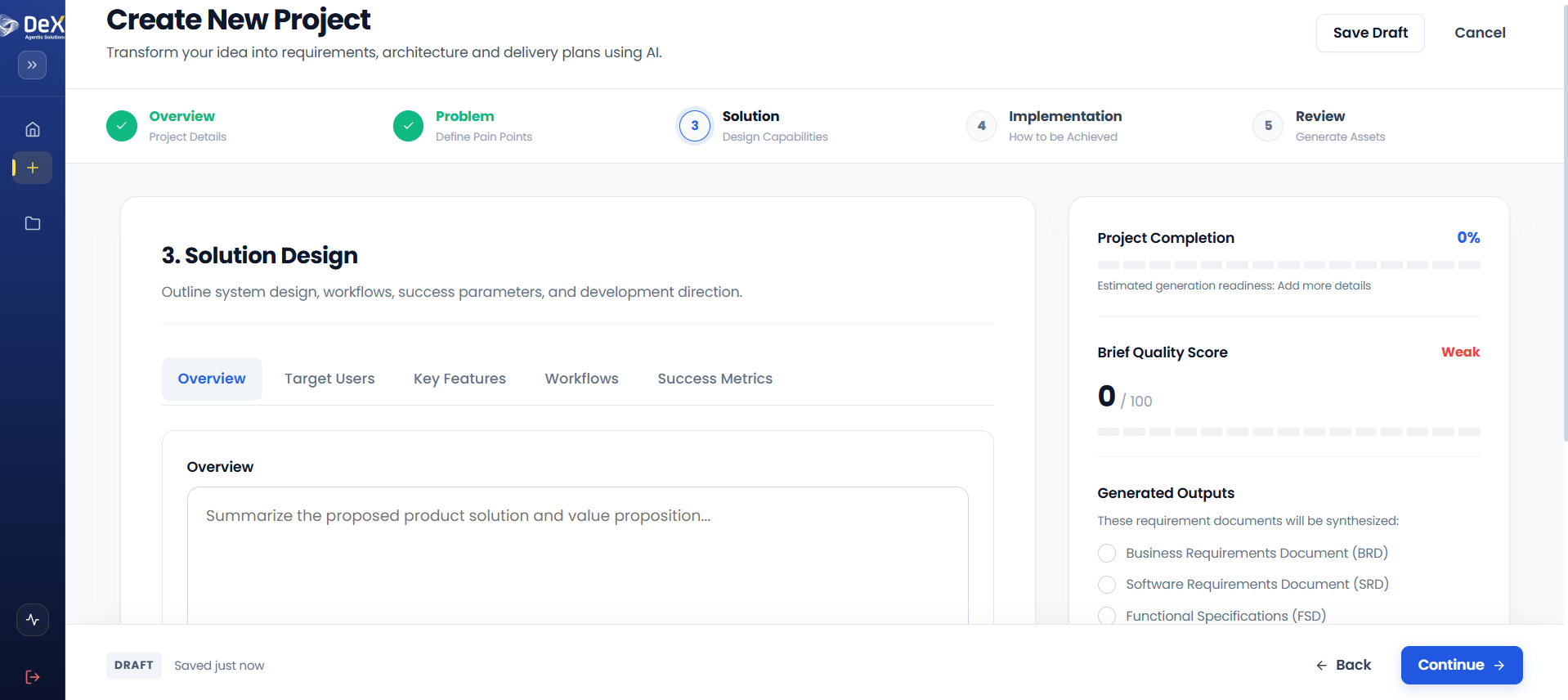
- Click Continue to proceed to Step 3 — Solution Design.
- Click Save Draft to store progress and resume later.
✏️ Avoid vague statements like "the system is slow" or "tracking is hard." Instead, name the specific pain point, the affected user role, and a measurable impact. Vague inputs produce vague BRDs.
Worked Example — Contractor Sync
This is where the Contractor Sync story actually starts. Here's the real situation that was typed into this field.
The Underlying Problem
Before Contractor Sync existed, a facilities services company managed cleaner attendance entirely manually. Supervisors and the cleaners themselves tracked clock-in and clock-out times over phone calls, WhatsApp messages, and end-of-day spreadsheet entry. There was no system of record — just a supervisor's memory and whatever a cleaner self-reported.
What Was Broken
- No reliable way to confirm a cleaner was physically present at the correct client site when they "clocked in."
- Constant manual data entry to reconcile phone-call check-ins into payroll spreadsheets.
- Disputes between cleaners and supervisors over actual hours worked, with no record to resolve them.
- No visibility for the business into real-time staffing coverage across client sites.
Who Was Impacted
- Cleaners — frustrated by disputes over hours and inconsistent pay.
- Site supervisors — buried in manual reconciliation work every single day.
- Payroll/Operations team — processing attendance data riddled with manual entry errors.
- Client sites — no transparency into whether contracted coverage was actually being met.
Failing Metrics
- Manual reconciliation time per supervisor: ~45–60 minutes/day.
- Attendance disputes: roughly 8–10 per week across the cleaner workforce.
- Payroll correction rate due to attendance errors: ~12% of pay runs.
The Problem Statement (as entered into DeX)
"Cleaner attendance across client sites is tracked manually via phone calls and spreadsheets, with no way to verify that a clock-in actually happened at the correct location or by the correct person. This creates daily manual reconciliation work for supervisors, frequent disputes over hours worked, and payroll errors in roughly 1 out of every 8 pay runs."
This single paragraph is what DeX's AI used downstream to generate the BRD's Executive Summary and Background sections (see Sample BRD).
Why This Step Matters So Much
Compare this to the BRD excerpt generated for the Loanmind AI project (a different, larger example from a lending platform), where the problem definition described:
Manual collection, classification, and verification of unstructured documents made underwriting smaller loans economically unviable for lenders.
Notice the pattern in both cases: a specific operational failure, a named impacted group, and a quantifiable cost. That structure is exactly what the AI engine is trained to extract and expand into formal business requirements.
🧩 The formula, in short: [Specific failure] + [who it hurts] + [a number that proves it] = a problem statement DeX can turn into a sharp BRD. Drop any one of the three and the AI has to guess — and guesses produce generic output you'll spend time fixing later.
What's Next
➡️ Solution Design — Describe what you're building, for whom, and how success will be measured.